
Most websites don't turn out bad because the agency was bad. They turn out bad because no one knew beforehand how such a project actually works – and therefore saved money in the wrong places, argued in the wrong places, and made decisions too late at critical junctures.
This article describes the process as it looks in practice: six steps, with timelines, costs, and the points where things typically get stuck.
Step 1: Clarify what the website should achieve (1 to 2 weeks, your work)
Before you inquire with anyone, you need an answer to a single question: What should happen on the website that isn't happening today?
"Looking more modern" is not an answer. Useful answers sound like this:
- We want 20 qualified inquiries per month instead of the current 5.
- Applicants should be able to apply directly instead of sending an email.
- Our sales representatives should be able to show customers the website without embarrassment.
- We want to maintain content ourselves, without asking the agency every time.
This answer determines almost everything else: the budget, the system, the structure, even the design. A website designed to attract applicants looks different from one that sells machinery.
Where it gets stuck: There are three different ideas within the company, and all three only come to the table in the second design round. Clarify expectations internally before inquiring externally.
Step 2: Inquire and compare offers (2 to 3 weeks)
Inquire with three agencies, not ten. And give everyone the same written description – one to two pages are sufficient:
- What you do and to whom you sell
- What the new website should achieve (from Step 1)
- Approximate scope: how many pages, which languages, which functions
- What materials you already have: logo, images, texts, color scheme
- Desired deadline and budget range
The budget range is the point most people omit because they fear they will then be offered exactly that amount. The opposite is true: Without a range, you will get offers that differ by a factor of ten, and three meetings where all parties talk past each other.
Why one offer costs 4,000 euros and another 40,000 euros
Both can be correctly calculated. The difference is almost never in the design, but in the surrounding factors:
| Cost Driver | Small Project | Large Project |
|---|---|---|
| Concept and Structure | Template adapted | Workshops, user interviews, site architecture |
| Design | One draft, two rounds of revisions | Design system for all page types and states |
| Texts | Supplied by the client | Editing, search engine optimization, proofreading |
| Technology | Standard CMS, standard functions | Interfaces to CRM, merchandise management, applicant tool |
| Scope | 5 to 8 pages | 60 pages, multilingual |
| After Go-Live | Nothing | Training, documentation, support |
To classify hourly rates in the German market: The Freelancer Compass 2026 indicates a median hourly rate of 90 euros for software and web development, surveyed among 356 respondents in this professional group. Experienced freelancers usually charge between 60 and 100 euros, medium-sized agencies between 100 and 180 euros, and specialized providers above that. A higher hourly rate is not automatically more expensive – someone who solves a task in 12 instead of 30 hours is ultimately cheaper.
Where it gets stuck: Offers cannot be compared because they contain different services. Demand a breakdown by item with estimated effort. A lump sum without a breakdown is not negotiable and not verifiable.
Step 3: Concept and Structure (2 to 4 weeks)
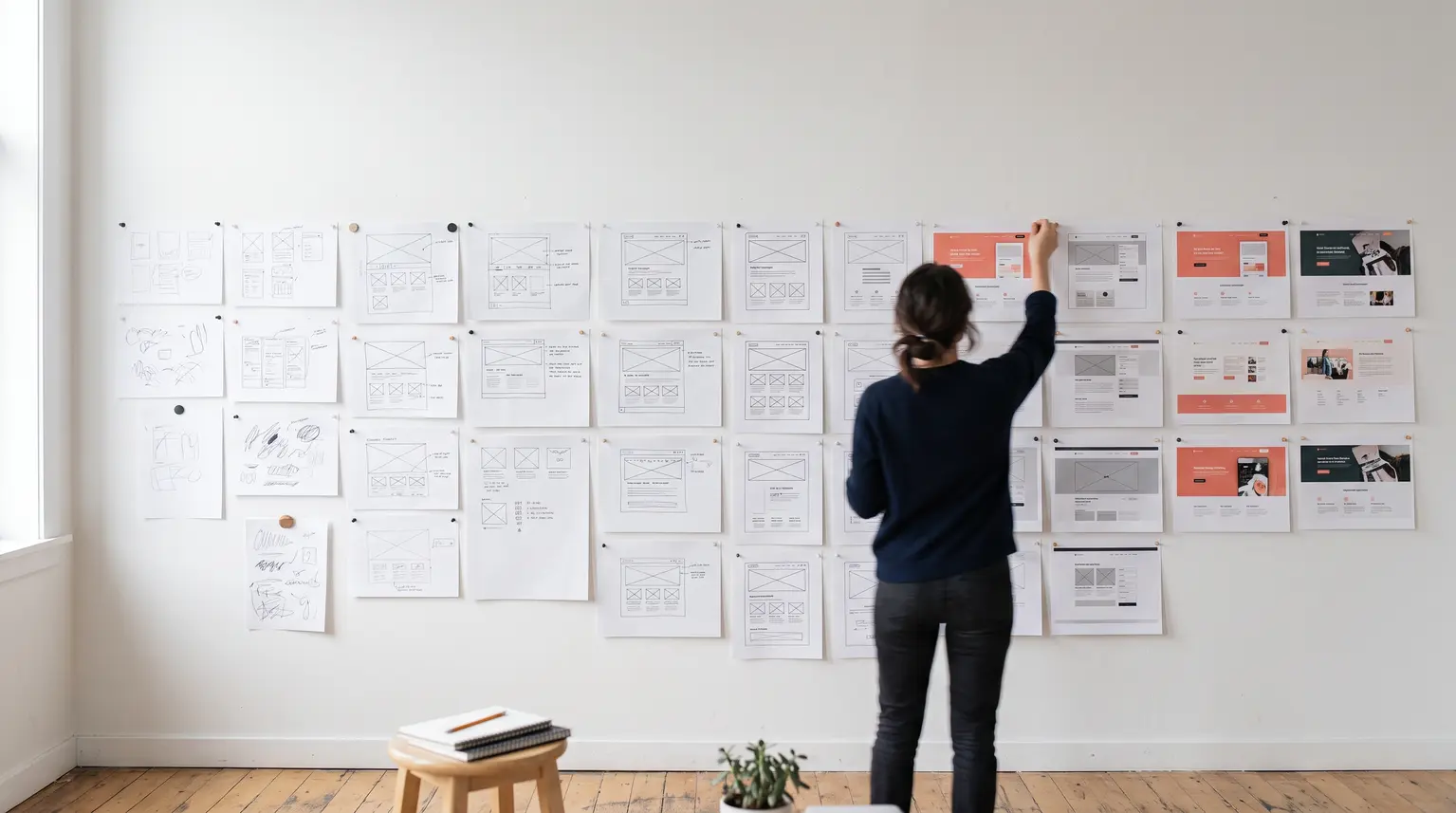
Now it is determined which pages there will be, what will be on them, and how visitors will get from the homepage to the contact form. The result is usually a sitemap plus rough layout sketches without colors and images – so-called wireframes.
This phase looks least like a result and is the most important. A design error costs an afternoon. A structural error costs half the project.
Where it gets stuck: The client wants to "finally see images" and pushes for the design phase. Those who skip the structure will later discuss fundamental questions on finished layouts – the most expensive time to do so.
Step 4: Design (3 to 6 weeks)
Typically, a draft of the homepage is created, followed by two to three more page types, then the remaining pages based on the agreed templates. Two rounds of revisions per draft are standard; anything beyond that is usually charged on a time and materials basis.
Three rules that keep design phases short:
One voice. Collect feedback internally and send it bundled. Three people with contradictory comments will generate four rounds of revisions.
Justify instead of evaluate. "I don't like the blue" is a matter of taste. "The blue is not our company blue" is information. "The button is lost on mobile" is a finding.
View on mobile early. More than half of visitors come from mobile phones, and Google measures loading time separately for mobile and desktop. A draft seen only on a 27-inch screen is only half-checked.
Step 5: Implementation and Content (3 to 8 weeks)
Parallel to the technical implementation, the content must be finalized. This is exactly where most projects get stuck: The website has been ready for three weeks, but 18 product texts are missing.
Therefore, clarify early who will write. If you write yourself, ask how many characters are needed per page and by when. If the agency writes, plan time for your technical review – copywriters cannot know how your machine works.
Where it gets stuck: Missing images. Stock photos are quickly acquired, but custom photos require an appointment with a photographer, and they have time in four weeks. If you want custom images, you must state that in Step 2, not in Step 5.
Step 6: Go-Live and the Time After (1 week plus ongoing)
Before going live, the following should be checked off: Redirects from all old addresses to the new ones, so that neither visitors nor search engines encounter dead ends. Privacy policy and imprint checked. Cookie banner correctly set up. Forms tested, including the question of where inquiries arrive. Loading time measured. Display checked on at least three devices.
After that begins the part no one thinks about when quoting: maintenance. System updates, backups, small corrections. For a normal corporate website, expect 40 to 250 euros per month, depending on scope and response time.
Where it gets stuck: A relaunch without clean redirects regularly costs a significant portion of visibility on Google. This only becomes apparent after four to six weeks when inquiries stop coming in.
How long does all this take?
For a medium-sized corporate website with 15 to 30 pages: three to five months from the first inquiry to going live. Those who need to be faster can achieve this – but only by reducing the scope, not by shortening the phases.
The biggest time sink in almost all projects is the same thing: approvals and content on the client side. If you want to speed up the project, that's the lever, not the agency.
The Quick Selection Guide
Choose the agency that asked the most questions about your business in the initial conversation and made the fewest statements about themselves. This is not a particularly elegant criterion, but it is surprisingly often correct.
Sources
All information last checked on September 8, 2026.
- freelancermap: Hourly rates IT freelancers, Freelancer Compass 2026 – Median hourly rate for software and web development, 356 respondents in this professional group
- Google Search Central: Redirects and Google Search – recommended procedure for relaunch
- web.dev: Largest Contentful Paint (LCP) – Measurement separated by mobile and desktop
The price ranges for projects, the time estimates per project phase, and the maintenance costs are empirical values from the German agency market, not collected data.